Showing posts with label genre. Show all posts

Tuesday, October 2, 2012

Short Story Greats

A list I'm on took some time recently to organize a list of great science fiction and fantasy stories throughout the medium. Here are the ones they came up with, with links to free versions online if they were available, and amazon if they were not. You can thank me later.

The Empire of Ice Cream by Jeffrey Ford

26 Monkeys, Also the Abyss by Kij Johnson

The Cold Equations by Tom Godwin

Harrison Bergeron by Kurt Vonnegut

The Ones Who Walk Away From Omelas by Ursula K. Le Guin

Flowers for Algernon by Daniel Keyes

Story of your Life by Ted Chiang

Bloodchild by Octavia Butler

All Summer in a Day by Ray Bradbury

Nine Billion Names of God by Arthur C. Clarke

All You Zombies by Robert Heinlein

A Sound of Thunder by Ray Bradbury

Tuesday, July 31, 2012

Space Magic

While I do try not to be picky about genre, I have to admit, it's a pet peeve of mine when people refer to things that have no particular relation to science as "science fiction". For example, one of the people I work with and I stopped in a room that had a TV tuned to what looked like one of those wgn magic shows- Charmed or somesuch, in which two demon creatures were arguing with a witch about the natures of spells and curses. I told the gentleman that I didn't care one way or the other about having it on, and wasn't paying much attention, to which he responded "I thought you'd be interested, you like science fiction."

In perhaps the opposite, complentary, horrific version of this, I was having a conversation with my stepmother about Margaret Atwood's Oryx and Crake and Year of the Flood, both of which we'd read. My stepmother was praising it for its extrapolations from current science on both genetic manipulation and climate change research. And I said to her, yeah, that's the sort of stuff I really love in science fiction. And she said, "no, I wouldn't call this science fiction. It's really more fiction based on science" (these books, by the way, are set in a mid-near future post apocalypse and revolve around genetically engineered food animals and a new iteration of created humans). That's exactly what science fiction is, I protested. It's there in the name! To which she said, no, stuff like star trek on the TV, they're really just making stuff up out of whole cloth. This was using real science, so it couldn't be science fiction.

I can't help but feel like this is somehow our own fault.

I've been using the term "Space Magic" somewhat pejoratively for a while to refer to non-scientific things that go on within science fiction, be they "the Force", about 93% of the show Farscape, John Carter of Mars, Doctor Who what have you. There's certainly nothing inherently wrong with space magic, and I know I'm like many people in that the Star Wars theme can make me feel like a wide-eyed eight year old ready for the adventure of my tiny life, and I absolutely love that the Doctor routinely opens the door of his flying police box (which is bigger inside than outside) onto the cold, sucking vacuum of space and sticks his head out like he's checking the weather.

But I do often feel disappointed when I open something billed as science fiction and get space magic, in the same way that, while I love strawberry ice cream, I'm going to be terribly cross if I find it in a carton labelled chocolate fudge. Every time the aliens are suspiciously hot human-like babes. Every time people take the word quantum to mean they can make up whatever they like. Every time someone reverses the polarity of something. Every time an organism experiences "evolution" as an individual creature and grows wings because its "genes understand" that it needs to fly.

I suspect not everyone feels this way, mostly based on the fact that these sorts of things are both common and popular, and often pretty fiercely defended by people who are making the claim that science fiction can be opaque to the less scientifically minded reader. Then they'll talk about how much they love things where guys with ray guns fight of giant space lizards and hacking in just knowing the back door the programmer left in the software.

I do sort of wonder, however, how much other people draw the line between science and space magic, and alternately how much I fail to draw the line in places where I lack scientific knowledge. When Mars needs women, how many people pat themselves on the back for how pro-thought they're being by enjoying it. When someone talks about the properties of the Higgs-Boson in a story, past being responsible for mass, how do I know they're not just pulling numbers out of a hat to sound cool?

And how much does it ultimately matter to a story?

On the one hand, I do actually love some good space magic, and if it's clearly marked and no one is lauding it as terribly thinky, I will sink my worm-hooks into that magic and ride it across alien deserts in the sky. Real science might even be unwelcome on this strange road trip.

On the other, I think it's maybe a bit like prestidigitation. For a story to hang together, there's an illusion that you have to be mesmerized by, even if you know it's an illusion. Perhaps something of an inverse bell curve of appreciation- there's the high where you sort of buy that something wonderful is happening, and as far as you know, it IS magic. Then there's something of a low where you know he's palming it, there's doves in the sleeve pockets, whatever. Then there's a rise on the other side where you know there's a dove up his sleeve and that he's drawing your eye away with misdirection to the other hand and some witty stage banter, but what impresses you isn't the dove appearing- you knew where it was. What you're watching is how he pulls it off, and the craft of the performance.

Maybe? Honestly, I think that's a better analogue for writing in general than it is for the pretense of science in science fiction, but there you have it.

Enjoy yourselves out there. 

Tuesday, June 12, 2012

I'm Not a Gamer

Every now and again, someone will link me to an article about another time where someone has complained about sexism either in video games or the gaming industry and the response has been at best to dismiss them. More often that they get swamped with hate mail and rape threats. I had been discussing one of these articles with a good friend and I said something to the effect of, yeah, I'd just come to accept that the video game industry and culture is hostile to me and doesn't want me as a customer (probably more accurate to say that the steps they would have to take make me feel welcome would alienate more of their current base than it would bring in in terms of myself and people like me). I know some perfectly lovely gamer gentlemen, but generally speaking, I'm okay with just writing the larger industry/culture off as a place I would not enjoy, and, if I ever doubt that instinct, it just takes one internet comment thread to convince me I probably did right.

But that did get me thinking about the things I won't cut ties with. Certainly science fiction has some atavistic little trolls lurking in its communities. And comic books seem to be in a race to the bottom in terms of drawing women as soft-core pornography. Is it a question of prevalence? Is it just that I can point to creators and creations within those other avenues that have been not only wonderful but friendly to me as a reader? Am I still okay with comics because for every Frank Miller and Dave Sim, there's also a Neil Gaiman and a Gail Simone (dreamy sigh! Gail Simone)?

What's our responsibility as consumers? As creators? At what point is it okay to just pack up and head for greener pastures and at what point is it morally imperative to say "no, this is mine as well, and I will not allow you to ruin it"?

EDIT 6/15:

You know, that all said, I've also been reading several things recently where people throughout the industry- not just the ladies- are stepping up and going "woah there, let's not just dismiss these complaints out of hand, and let's conduct ourselves like decent human beings". I apologize to anyone I offended or slandered with too broad strokes.

Tuesday, May 29, 2012

The Perils of Classification

So, one of the podcasts I'm working my way through is Adventures in SciFi Publishing, and in an episode I listened to recently (I think it's still several years old) they were talking about why Fantasy outsells Science Fiction. As their example, they gave the Lord of the Rings as the best selling fantasy work of all time, weighing in at 150 million copies sold. For the best selling science fiction novel, they gave Dune at a modest 12 million copies.

And my immediate thought was "Dune? Really?"

Here's the thing (this information is coming from Wikipedia):

Dune sold 12 million copies.

Charlie and the Chocolate Factory sold 13 million.

But, okay, Charlie and the Chocolate Factory doesn't really have science, even if it does have monsters and weird cultures and fantastically advanced machinery. The "science" is mostly magic anyway, and it's not really integral so much as a set piece and plot convenience. And it's for kids anyway?

The Hitchhiker's Guide to the Galaxy sold 14 million.

Okay, I mean, sure, it's in space and all, and there are aliens and robots. And it includes both the origin story for the world and the end of the universe. But it doesn't count because it's funny... I guess?

Nineteen Eighty-Four sold 25 million copies, more than twice Dune.

Surely when people think science fiction, Nineteen Eighty-Four comes to mind? I grant you it's not hard science heavy, but this thing is like the patriarch of dystopias.

Here's the big one though. There are two books that have officially outsold Lord of the Rings.

The first, and best seller of all time, is Tale of Two Cities by Charles Dickens. The second is a story about a  travelling alien resident of an asteroid who comes to earth to see the world from an outsider perspective, and to discover profound truths about life: Antoine de Saint-Exupéry's Le Petit Prince (200 million copies, which, if you're keeping score, is Lord of the Rings plus four Dunes and some change).

Now, that's a children's book, and not per se full of what you would call science, but I'll contend if you line it up next to Doctor Who it's not out of the ballpark. Putting the word "quantum" in front of something doesn't actually make it scientific.

I think part of the problem with BOTH science fiction and fantasy is that they've evolved these really weird distinctions about what's really science fiction or what's really fantasy- borders that are fiercely defended by the more vociferous fans out there, as I'm sure any Urban Fantasy reader will tell you. Nevermind fans of Twilight. And they're not really consistent. Why WOULD you count Dune but not Nineteen Eighty-Four? Why is Star Wars science fiction? Why is John Carter of Mars? Why ISN'T Atlas Shrugged (a book which, mind you, is set in the future, deals with the outcome of societal decay, and has material stronger than steel, a cloaking device capable of hiding a whole valley, a sonic death ray, and an engine that produces limitless free energy, all as major points of the novel)?

The explanations actually given for why Science Fiction (undefined) sold more poorly than Fantasy (also undefined) despite the individual performance of some books were:

1. The market permeation of Lord of the Rings and a desire left in its readers for more books of similar scope and subject (which I think is a fair and excellent point, and demonstrable in authors like Terry Brooks and Christopher Paolini).
2. The science itself is a hurdle many readers either can't or don't care to overcome (this one gets a meh from me, because there's such a wide range in science fiction- there's a lot of it where attention to scientific detail actually hurts you)
3. More women read than men, and women have traditionally preferred fantasy (reasons given for this were the boys own adventure quality of a lot of scifi, the greater representation of strong females in fantasy, the science is hard argument above (grr), and the kind of insular and off-putting elitism found in some of the science fiction fandom).
4. They also kind of flirted with the idea that fantasy tends to be more character-oriented and science fiction tends to be more idea-oriented.

One thing they didn't mention, but which I hope they do as the discussion goes on, is that a lot of the fantasy on the best seller list here is kid friendly. Some of it is out and out FOR kids, but most of it is stuff that both kids and adults can read (Little Prince, Lord of the Rings, Hobbit, Narnia (okay, that one's iffy), Harry Potter, to name a few). Cutting out either kids or adults reduces your audience pool, and let's be honest, if there's any one group that's at a disadvantage, generally, for understanding (or sitting patiently through the explanation of) the science, it's young kids.

Friday, May 25, 2012

World SF Blog

Check out the World SF Blog! They do science fiction from around the world. Plus sometimes they post fiction. 

Oldest and Fatherless

This one's just a bit of fun, fannish fluff, but it's a different take on Tolkien's Tom Bombadil. 

Saturday, May 19, 2012

Nick Mamatas on Laurel K. Hamilton (which, in retrospect, sounds kind of dirty)

Just an article on why Laurel K. Hamilton commands as much market share as she does, and why she deserves to. 

Friday, May 11, 2012

Non-Western Science Fiction Roundtable

Locus Magazine Roundtable of folk talking about non-Western Science Fiction. It goes deconstructionist pretty fast, but I think it's worth reading and thinking about. Ends a little abruptly though. 

Tuesday, April 10, 2012

The Human Accrued Continuity Omnibus

Yes, I'm a dork, and if you catch the joke with the acronym, you have no room to throw stones.

Anyway. 

At irregular intervals, the imp of the perverse will scrabble the idea into the back of my skull that I really ought to try my hand at some sort of alternate history, which generally results in me doing forty straight hours of fascinating but ultimately inadequate research. Human events are connected in all sorts of weird, fun ways. One dude, albeit one powerful dude, William Randolph Hearst, near-single handedly drums up US sentiment against Spain and helps drag us into a war of colonial acquisition- a war which provides a backdrop against which an officer by the name of Theodore Roosevelt can distinguish himself on the national stage, ultimately making it possible for him to run for president and securing a legacy which aids to power other members of his family including his somethingth cousin/nephew-in-law Franklin Delano who nearly ends up president of the United States for life and creates the New Deal programs and so on. And less direct paths- the books and people that the powerful and the insane cite as inspiration.

I don't tend to think of history as the story of powerful charismatic dudes directing a horde of mindless chess pieces, but there are undeniable bottlenecks- places where things break if just one pieces is out of alignment. Maybe instead of Nietszsche's rants on will and superhuman men, what really breaks through the shell of a young, impressionable Adolph Hitler is a bit of translated Buddhism- or a little bit of Thoreau. Or maybe instead of quite so much Thoreau, Gandhi reads a little more Nietzsche and decides that what an oppressed India needs to get itself out from under the thumb of British oppression is a bit of the ol' triumph of will? 

At any rate, yeah, the small links that make up a long chain of events.

It's too much work for one person to chronicle that sort of thing- what inspires people, what leads to what.

But it's really not too much work for crowdsourcing.

This is just kind of a twinkle in the eye idea. I'm sure it's doable, likely with existing technology. An interlinked series of causes and consequences that you can click through and follow, maybe even in some sort of automatic graph ("magic box, I'd like to view a tree of consequences of the invention of rum, four iterations down, please"). 

Heck, it's possible somebody's already started doing it.

I'm just saying I think it would be cool. 

Tuesday, February 28, 2012

Tuesday, February 21, 2012

On Tribe

Oy, out there. Oy, I say!

I get, I really do get, that it's human nature for people to put up totems, to define themselves as one group, to mark everybody else as outside people, and to loudly proclaim how it's the inside people who are the best and the rightest. It's tantalizing to belong, to feel special, to have a sense of an order in which the things you associate with yourself are of central importance.

But really, relax and get to know your neighbor. It's totally worth it.

So I got to see the Circle Jerks play at one point. It was, all in all, a pretty good show, but I was struck especially at one point when Keith Morris, in between songs, urged the people who had come to see his show to look around the whole festival, and not discount the techno and house stuff, because some of it was really cool, cutting edge music. He actually had people boo back at him.

I get liking something, and wanting something more of what you like. There's absolutely no evil in that. I think the problem is when we start to define ourselves as Spaceship and Explosion people, or Dragon and Elf people, or Only in the New Yorker people. I hear genre folk talk about literary fiction like Jane Austen is hiding under their bed ready to strangle them if they put down their light saber. I read people over and over again talking about the defining differences between the way literary and genre fiction writers think (and when you provide counter examples like "what about Kafka?" or "have you read Gene Wolfe?" mostly they blink at you and go "well I haven't read that one specifically").

I am infinitely richer as a reader and a writer for having read Nabokov, Austen, Tolstoy, Faulkner, and Hemmingway, and I consider myself a pretty straight genre person. It's not something to be afraid of. These guys aren't some tribe from over the mountain that sacrifices to strange unholy idols and has a blood feud with your people. They're more like the aunts and uncles you don't talk to enough. Go and say hi.

Seriously, guys. It's okay. Take off the war paint and put down the standards for a bit. Make a fruit basket and go say hello. I bet you'll be glad you did.

Monday, January 9, 2012

Review: Arcane, Edited by Nate Shumate

Arcane, edited by Nathan Shumate, can be bought here. Kindle versions also available.

Short Version (for those who hate to read, but still want to buy a sizable anthology):

Good solid mix of dark, unsettling stories, with more light and funny stories thrown in than I expected. Some prose-pretty and interesting format pieces, some faster paced and action oriented ones. There's going to be something here you like, especially if you like the undead.

Disclaimer:

In the interest of full disclosure, Jonathan S. Pembrook, whose story "A Capella" is the second in the book, is a good friend. As such, I feel it's incumbent on me to tell you fine internet folks that you may as well just hand him the Hugo and Shirley Jackson Awards now, and not bother with the formalities of voting. In all seriousness though, he does get first mention because he's my buddy, but this is a story that made me wince. Physically. In the good way and more than once. And that's coming from somebody who accidentally writes cannibalism stories. It's a story about disassociation and making art, and it lives up to that promise with startling acts of casual cruelty. The format is classic style soft sci-fi, the detail is close-up horror. It's a nice mix, which is actually a pretty good microcosm for the rest of the anthology.

My Favorites:

CORPORAUTOLYSIS by Christopher Slatsky

I love language and atmosphere, and this story layers on ambiance like a fine and desolate parfait. It's about grief and losing touch. It's also about mushrooms. And it's awesome.

IT’S NOT THE BOYS IN THIS FAMILY THAT HAVE TO WORRY by Brady Golden

It's really something when a story can take a setting that is in and of itself a little horrific (an isolated, controlling, cultish family compound), and take it to a place that's infinitely more horrible. The fact that you see the end coming is, I think, part of the appeal. The story itself is about inevitability.

INCIDENT AT THE GEOMETRIC CHURCH by David McGillveray

There's a theory that what you don't show is always scarier than what you do, and I think that makes the oblique found-object structure of this Lovecraft-esque avant garde band story such fun. There are some more traditional and straightforward stories in this book, but this one does the best at coming at things sideways.

THE BEST AND BITT’REST KISS by S.K. Gilman

A story about poetry, love, habit, and the mortuary arts. The character of the mortician in this particularly shines.

KISS OF DEATH by Jeremy Zimmerman

This is one of the light ones. Actually I was delighted by every single funny story in this anthology ("The Truth About Mother" and "All Coated in Bonemeal" are also straight up hilarious, which you don't always get in horror). Of the three of them, this is my favorite, because it speaks to the part of me that has played Dungeons and Dragons since I was a kid. It's also a very special sort of relationship drama.

I could go on. "We Belong to Her" is a great opener with a pitch-perfect feel of being in the historical moment. "Reyes Rides the Deville" is delightful post-apocalysim. "Mallecho" has a very Shirley Jackson vibe to it, and I mean that in the best way. "Beneath the Arch of Knives" is whimsical and playfully cruel. "God of the Kiln" plays off its two narrators nicely to tell a story that feels very classic, even Kipling-esque in its presentation. "In One There Is Many" features a zombie feeling tenderly paternal toward his maggots. "Black Bush" has a beautiful, poetic, trashy, intensely southern voice that's just as welcome at the end as it was in the beginning. I actually feel kind of guilty not mentioning every story, but it's a very big book.

The Less Shiny Spots:

I think no matter what you like within the realm of dark stuff, there's going to be something here for you. The flipside to that is that there will be a few that are there for somebody else. I couldn't get into "The Delivery," for example, but I bet if you're a fan of Grant Morrison you'll enjoy it quite a bit. It's got that manic surrealness to it that feels like his work.

There were also a couple of places where I wondered why stories were positioned as they were. A third of the way through the book seemed like an exceptionally masculine anthology (not an inherently bad thing, just something that stuck out). Not flatten-a-beer-can-against-your-head macho; the stories were about fatherhood and obligation and being master of your own house/world/workplace or not. Enjoyable but definitely enough to make me notice. Then suddenly it shifted and the ratio went in a different direction. There was also a place or two like "The Best and Bitt'rest Kiss" running right before "Visiting Hours" where I feel like the subject matter being so close worked against one of the stories. On the other hand, it's an anthology, and you're really free to skip around as much as you like.

In Summary:

This is a very solid collection. You might not like everything because it's very varied, but that's to its strength. It showcases a broad range of talent and stories that bring in a myriad of subgenres. Did I mention how big this book is? Even if you're a very fast reader, it's days of entertainment.

Actually I feel like I've already said everything I need to. Go pick it up. Support dark fiction authors and expose yourself to a few surprises. There's no way you're anticipating everything in this book, and the best part of the genre is the things that jump up behind you and go "boo".

Table of Contents:

5 INTRODUCTION: YOU GOTTA HAVE A GIMMICK Nathan Shumate
7 WE BELONG TO HER Joe Mirabello
27 THE TRUTH ABOUT MOTHER Van Aaron Hughes
41 THE WEB OF LEGENDS Damien Walters Grintalis
45 REYES RIDES THE DEVILLE Dan Cavallari
57 THE HEART OF THE MATTER Paul L. Bates
67 EL DIABLO DE PASEO GRANDE Milo James Fowler
83 THE DELIVERY A.A. Garrison
97 CORPORAUTOLYSIS Christopher Slatsky
107 MALLECHO Stephen Willcott
111 GOD OF THE KILN Eric Francis
123 TIED D.T. Kastn
137 LADY OF THE CROSSROADS Christine Lucas
149 BENEATH THE ARCH OF KNIVES James Lecky
159 ALL COATED IN BONEMEAL Bartholomew Klick
165 POSSESSED OF TALENT Thomas Allein
173 SWEET HEAVEN IN MY VIEW Frank Stascik
179 IT’S NOT THE BOYS IN THIS FAMILY THAT HAVE TO WORRY by Brady Golden
191 KISS OF DEATH Jeremy Zimmerman
205 LEGACY S.M. Williams
221 AN UNQUIET SLUMBER Rhiannon Rasmussen-Silverstein
233 A FRIEND, THE SPIDER Caitlin Hoffman
239 DESTINATION UNKNOWN Anthony J. Rapino
245 IN ONE THERE IS MANY Max Vile
257 INCIDENT AT THE GEOMETRIC CHURCH David McGillveray
265 BLACK BUSH Gemma Files
289 THE BEST AND BITT’REST KISS S.K. Gilman
305 VISITING HOURS Josh Strnad
309 SWEET DREAMS Fran Walker
321 THE BUSINESS OF HERMAN LACZKO Mark Beech
333 CONTRIBUTORS

(If you're one of the authors and I was not able to find your personal webpage, or have linked to an incorrect or outdated page, just let me know and I'll fix it)

Tuesday, December 27, 2011

Women Fighters In Reasonable Armor

Just what it says on the label.

Also, I love you, tumblr. Let's get married and have cyborg babies.

Tuesday, November 15, 2011

The Superhero Genre

I know that I've mentioned my love of the Superhero genre before, even though I don't really write much in it. In part, it comes from my love of comics and animation, and I do take in a lot of both that have nothing to do with people with strange obsessions putting on tights and capes and beating up street thugs and space invaders. I like Sandman and Bone and Transmetropolitan and Strangers in Paradise. But I also really love Superheroes.

I don't know if part of it is a hold over from growing up reading X-Men- the sort of crunchy sweet nostalgia that makes you adore something you rationally know is silly or bad for you. I think that's part, but not all of it, because I can certainly recognize good and bad stuff within the genre and I really do think when it's good, it stands up well against any other genre I enjoy reading, with its own little tropes and idiosyncrasies that it comes back and tries to address (you couldn't very well have had Watchmen or Identity Crisis if you didn't have a set of expectations).

Actually, when you get right down to it, I think the tropes are why I love it. Because superheroes are a genre that's grown up in comic books principally aimed at kids, there's a lot of inherent ridiculousness that's not only gotten a pass, but become enshrined as a genre hallmark. Superman can hide his identity just by wearing glasses. One single mutant gene produces a limitless array of magic powers including controlling the weather, super speed, talking to machines, laser eye beams, turning into metal, and randomly cutting from our dimension to a hell dimension full of monsters and back with a precision that allows you to get wherever you want to go. It's not weird for there to be man-eating alligator people in the sewers. Batman has a billion dollar computer inside a secret cave that can monitor and analyze whatever he wants. The Flash can run into things faster than the speed of sound and not become  a red and yellow smear against them. One crazy person in a mask with a few fancy gadgets is more effective than either the army or the police. The best way to fight crime is in brightly-colored, skin-tight spandex. The only other genre I can think of that has near as many completely accepted bits of utter insanity is Fairytales.

But let's be honest, I'm also a big fan of Fairytales. It's the juicy archetypes and tropes that become something terrifying and ridiculous on close scrutiny. It's the fact that readers have some very concrete and silly expectations waiting to be defied or refined in a million different ways. Or alternately, lived up to in ways they didn't expect.

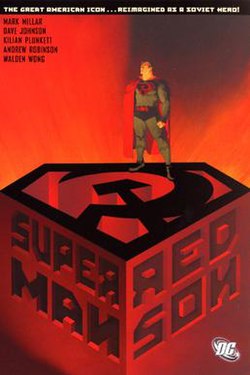
Also, in a way very much like Fairytales, Superheroes have gotten bigger than whoever's currently writing them. Because these guys come out in comics that are printed generally once a month, with a rotating stable of authors, and in many cases with canon alternate versions of themselves and constant reboots and redefinitions, nothing about them is particularly fixed. It can be hugely frustrating if you're a reader who's been following a character, getting to know and love them, watching them evolve over an arc, only to suddenly find they're not behaving like themselves anymore. But on the other hand, it means that you're looking at the worlds and the characters almost through a hall of mirrors, with a million different acceptable distortions, so long as the essential characteristics are maintained. One of my favorite things ever in all of comics is called Superman: Red Son, by Mark Millar.

It's a stand alone, which is generally my favorite type of superhero story, in part because of the problems expressed above, and it's also a "what if?" story. In this case "what if instead of landing in middle America and being raised with all the wholesome American ideals that make Superman the guy we know and love, he came down in the Ukraine and was raised to be the paragon of communist values?" It's a fun, smart treatment that uses a twist on a very iconic character to talk about the cold war that dominated so much of the last century.

Then of course too you have things like Alan Moore's Watchmen, which takes the perspective of trying to look at what kind of people would really put on tights and punch criminals, and just how screwed up you really have to be to do so. (The League of Extraordinary Gentlemen, also by Moore, is superheroes as per English pulp/adventure literature of the 19th century, and it's quite a hoot.)

Another good one is Vaughn's Ex Machina, which is about a superhero who decides he could actually do more good in politics, and runs for and wins the mayorship of New York City. There are flashbacks to his tights and jetpack days, but it focuses more on what it means to do good and to make a difference in a world that doesn't just have super powered serial killers, but also the kinds of moral and social quandaries we deal with every day.

None of this is to say I don't enjoy straight superhero stories, because I really do. It's thrilling to watch one person or a handful of people stand up to comically exaggerated violence and terror and win (though my preference is often for the off-beat heroes where the licenses leave more room to goof off and experiment. The Question, Booster Gold, Green Arrow, Birds of Prey, Secret Six, Plastic Man). And some of the straight stories, particularly in the Batman and X-men lines, which do some of the most business and consequently attract some of the absolute best artists and writers, are well worth reading. There are also some absolutely wonderful writers who are absolutely worth following no matter where they go: Alan Moore, Neil Gaiman, Gail Simone, Brian K. Vaughn, Warren Ellis, Mark Millar, Robert Kirkman (some people would also say Grant Morrison, who I'm more ambivalent to. Some others would also say Frank Miller, but I really have to draw the line there).

It's not that there aren't problems with the superhero genre. There's a lot of places it lends itself to jingoism, simplicity, misogyny, senseless violence, and irredeemable silliness. It is still a pulp genre, after all. But the beautiful thing about it is how big and how diverse it actually is, and for everything out there that's rote good vs. evil ultraviolence or cheesecake exploitation, there's someone else pushing a fascinating character to their outer limits, asking unanswerable questions, and making you look at the world in a way you only can when you give individual characters agency that extends across the laws of physics. As uncle Ben said: with great power comes great responsibility. And whether the character you follow is equal to it or not, that by itself is a great story.

Saturday, September 17, 2011

Shameless Angry Black Woman Repost

I love the Angry Black Woman blog for a number of reasons. The post linked here is a gem from the archives about potential ways to improve diversity among speculative fiction markets.

(I think the kind of underlying question is: "Do you believe diversity in genre fiction is a goal worth expending effort toward?" Obviously Angry Black Woman thinks yes, and I agree, but I think the other side is less "Eeek, diversity makes me terribly uncomfortable!" and more "eh, it SOUNDS nice, but wouldn't that take more work from me?" So really it's not just do you agree in principle, but are you willing to work for it?)

Tuesday, September 13, 2011

Speak Out With Your Geek Out


This post is in conjunction with Speak Out With Your Geek Out week, which is a big round of blog posting to help all those people who have internalized the negative connotations of geekdom, even as we move into an era of computer phones, cloned organs, and widespread pop culture references to hobbits and orcs.

I'm not doing too badly for myself. I'm an emergency medical technician on my way to full paramedic and a published writer of fantasy and horror. I've gotten to travel all around the world, including Belize, Japan, Egypt, France, Mexico, China, and exotic Canada. I've worked on an archaeological dig, jumped out of planes, ridden camels across a desert, climbed cliff faces, swum with sharks, modeled nude, met one US president, and breathed for a cardiac arrest patient.

I'm also a geek on a number of different axises. I've always read fantasy and science fiction, I love and continue to read comic books, I enjoy role playing and boardgames, I love both western animation and anime, I've been in and out of massive online multiplayers since the web connections were pay-by-the-minute, I've made lasting friends through internet fandom, and I have, on more than occasion, larped. I've also met more than one boyfriend through these activities.

Being a geek isn't something that limits you. It's a passion. It's a light in your life that you can hold up when things are looking dark. It's having tried to live up to being a knight or a paladin, even just as an exercise. It's understanding the prime directive and knowing why it's there. It's learning planetary physics because you want to design a city in the clouds. It's knowing that with great power comes great responsibility, and having planned out what you would do if you had the good luck to get a radioactive spider bite. It's about a powerful combination of imagination, enthusiasm, and precision- about being able to ask “what if?” and then provide the answer. It's about an intimate familiarity with a body of work that asks over and over again “what does it mean to be human?” and “what does it mean to be good?”

I'm a lot of things in addition to being a geek, but I could never have been the whole person I am today without having imagined myself as an X-man, without having cried during Ender's Game, without having learned to draw every character in Ranma 1/2, without wearing a shine into my wasd keys in multiplayer games, without learning the mechanics of storytelling by relentlessly picking apart TV shows and putting them back together the way I thought they ought to go, or without the friends I made because we had these things in common.

And that's not all. I have a friend who used to win anime cosplay competitions. Now she does makeup and special effects for Hollywood movies. One friend who played the Star Wars tabletop roleplaying game with me is a practicing lawyer. Another is a professor. The biggest, sweetest firemen I know carries a toy tricorder in his pocket. The first guy I ever fell in love with could demand chocolate in Klingon. I once had a really surreal conversation with the front man for a punk rock band and the giant bouncer at the door about how much we loved dungeons and dragons and the renaissance fair.

If you're feeling down and alone, you shouldn't. There are a lot of us out here, and we're not always who you'd think.

If you're feeling like what you love makes you a loser, you shouldn't do that either.

The stars are the limit.

Friday, September 9, 2011

I Think I Actually Cried a Little

Who wants to see the sweetest, most nerd-girl affirming site ever?

Saturday, August 27, 2011

Cosmos Latinos

Ohmigod, YES!

I've been looking for something exactly like this anthology. It's good to know it's out there.